
The Art of the Bloom
A Conversation with Russell Young

Artist Russell Young lives and paints where art meets flora. Influenced by 17th-century Dutch masters and the wild California landscape, his massive floral works are a meditation on shared mortality. We sat down with him to talk about his creative process and his lifelong obsession with nature.
Hello Russell, how are you? Can you tell us a bit about yourself, who you are, where you’re based, and what you do?
I’m an artist living and painting on the edge of America. I grew up in Northern England watching American westerns and movies with icons like Marilyn Monroe and Elizabeth Taylor, so it didn’t take long for me to realize this innate desire to get to California. Now I’m here and it’s like nirvana.
I initially came across Blumenhaus the year before last when I bought a copy of the first issue in the Gucci Gardens in Florence. The journal is so wonderfully put together and well written, so I was really transfixed. I was looking for a reference for the garden at my new house in Southern California, and it felt like a match made in heaven because the two loves of my life have always been art and flowers.

What is it about flowers, as a subject, that captivates you as an artist?
I have always had a love of flowers. I’m fascinated by how they work, how they move, their colours, the way light interacts with them. I’m currently obsessed with peonies.
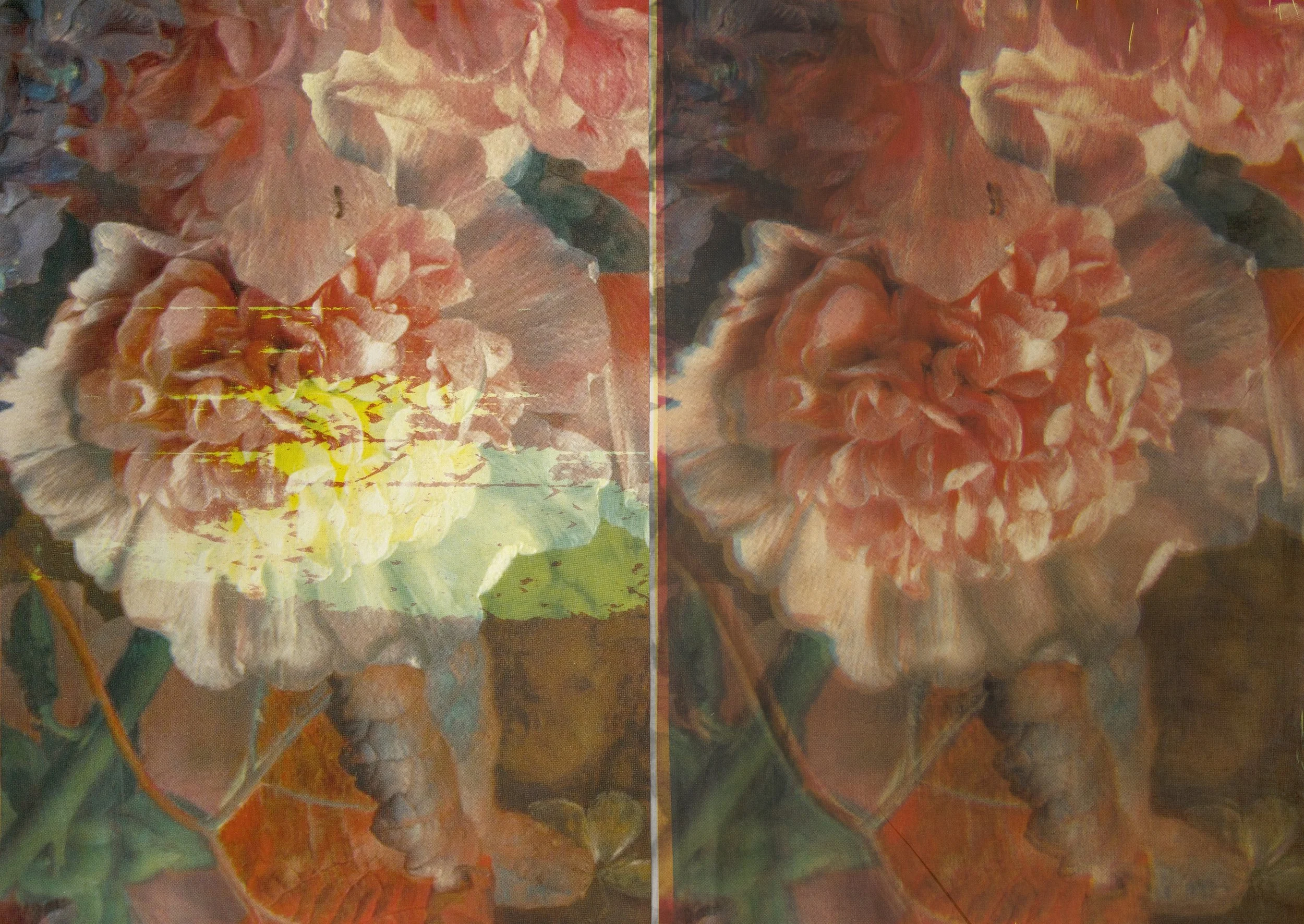
I had enough knowledge of flowers by the age of ten that I’d notice the impossibility of classical floral still life paintings on display in the museums that my father would take me to, and I would tell him how none of them were real because, of course, the flowers and plants they depict are famously all from different seasons. I remember thinking how unusual it was to see elements of these flowers’ decay because you go into a museum thinking everything is going to be perfect and pristine, but, I thought, hang on, there’s a hole in that rose, there’s a bee, an ant, a slug, whatever it was. So that’s a little bit of the history of where all this came from, out of the greyness of Northern England and coming across these wonderful shocks of colour.
Nowadays, I don’t think there’s ever a time when there aren’t flowers in the house. There are cacti everywhere right now. There’s a vase of flowers in front me that are wilting. Flowers have always reminded me of the cycles of life and death.
Can you talk about the inspiration behind your FLOWERS series and what you hope to communicate through these works?
When New Order’s Power, Corruption & Lies came out in 1983, I was living in London at the time. They normally had very dark covers, so it shocked me when I first saw the album sleeve. The artist who originally painted those flowers, Henri Fantin-Latour, and the colour swatch on the side—it blew me away because it was so unexpected. It took me back to my childhood and reintroduced me to that world of flowers. So that obviously stuck with me and its influence is undeniable in my FLOWERS series.
The images I pull from are all Dutch 17th Century paintings, and almost all of them are actually by women artists of the time, which I think adds an interesting extra layer to the work because a lot of the painters that are often remembered from the period are men.
Some of my paintings are really massive, like six panels stitched together. All of them are close-ups of the images they depict, sometimes consisting of a single percentage of the whole painting they reference. You see the moths and caterpillars and all the little memento mori—I like that they’re imperfect. I’ve never understood all these garden and flower shows in England where they try to get the perfect stem or put together the perfect arrangement. I’d rather spend time watching them blossom and then wilt.
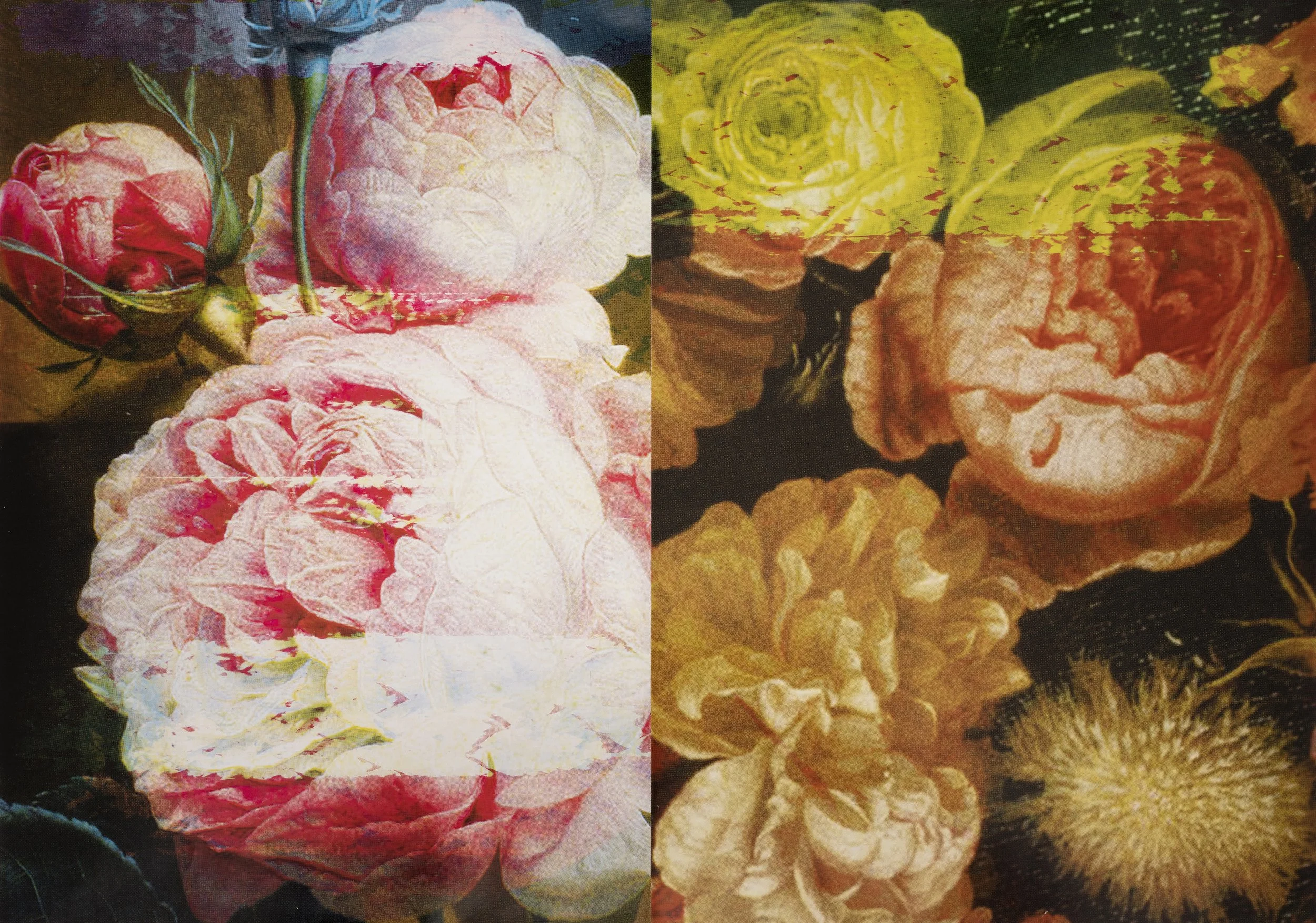
Could you describe your creative process to create your large prints?
They’re extremely physical. I’ll go into the studio and emerge hours and hours later and completely lose track of time or forget to flip the records playing in the background or discover I’ve cut myself. It’s about being completely lost in the creative act. The physicality is in the materials, too. I want streaks in the painting, I want to see them stitched together. In regards to the flower works, it’s about embracing decay and impossibility. How is it that a poppy that grows in spring is alive near a rose or peony that grows later in the year? It’s a fantasy world.
How does your personal relationship with nature influence your artistic approach?
I found a picture of me surfing the other day and I’m the tiniest dot amongst these huge waves and there are rocks in front of me out of frame and I don’t have a care in the world. I’ve just started to get back into surfing again, and I’m still going to go out into the mountains to hike back under moonlight. This kind of thing fills me with creative energy. I’m very aware of the reality of my body but inside I’m still like twenty-seven years old and that will never change. I don’t ever want to slow down. The body is this vessel I’m moving through and it’s the thing that will ultimately fail me (it’s partially failed me a few times already) so whenever I choose to do something new, it always comes out of the here and now.

Your work often explores the complexities of the human experience. Can you elaborate on some of the key themes that you find yourself returning to?
Certainly the fantasies and complexities all come into play no matter the subject matter.
People still ask me every other exhibition about the Marilyn Monroe work, asking if I took the photo. I laugh because I was three when she died. Most of my subjects are dead. I actually gave Elizabeth Taylor one of my paintings just before she died. Whether it’s a flower or a person, I like to focus all my attention on them because it’s what makes me interested in the world, and, like memento mori, it’s about remembering our shared mortality.
In the last year, this has come into more focus. A lot of people I’ve known have died. My mother is 98 years old. Flowers decay and pass on, as we all know, and there is no flower that always remains in bloom. They parallel our own lives.
How has your personal journey shaped your artistic vision and the subjects you choose to explore?
There are scenarios all around the house right now. I buy people’s pottery these days, so those are found in spots here and there, and there are cacti around, some of which sadly got frostbite because they were outside during a cold spell. Our mortality is an interesting thing and we encounter it everyday in big and small ways. I suppose these ‘scenarios’ are ways to engage with that process and live an artful life.
Can you speak about a pivotal moment or experience that significantly impacted your artistic development?
The first time I realized that I was an artist without really knowing what it would all entail was when I was three during Christmas in Northern England at my aunt’s rather large house. There was a forest behind her garden, all the leaves had fallen and the treeline looked like ‘scary shapes’ that were dark against the gray sky. My other aunt had bought me these huge pieces of paper and beautiful graphite pencils and I sat in front of this light in the window and drew these scary trees. I’d start in the middle and make heavy marks. I remember losing myself in the paper, the trees, the shapes, and the ways the branches dissected each other, the chaos of all these limbs. I kept drawing over the next three or four days and one of my aunts asked me, ‘Where did you start?’ And she knelt down and pointed to the exact first mark that I had made. I felt like I was having my first serious conversation with someone, and it was based in nature.
Since day one the pivotal moment for me has been nature. It’s been trees. It’s been my father’s garage because it was full of ant nests, butterflies, worms, and any animal I could find; I had to create these little worlds for them. I would always go outside into forests or fields and create watercolours or drawings. During the pandemic lockdowns, I created a whole series of raptors flying above the studio, others of trees in the surrounding area, and others in a place above the mountains called Rose Valley. It’s always been about being immersed in nature.
Your work often seems to juxtapose contrasting ideas. What draws you to these juxtapositions, and what do you hope to evoke in the viewer?
I don’t see them that way or think about them if those juxtapositions are indeed there at all. I have to create for myself. But at every exhibition I see someone looking and I watch as their face lights up; there’s this happiness or curiosity and that’s how people are being impacted by the work. I don’t set out to do that, to evoke any particular thing, but it’s one of those unintended consequences. That’s why I have so many different kinds of work from the abstract paintings to the diamond-dust portraits to these flowers.
Rick Rubin talks about not worrying about what other people think. Any creative thing you do should be a diary entry. Whatever it is should be true to yourself and you shouldn’t worry about who will see it or why or if it's commercial or not. My three closest friends who were photographers and artists all burnt everything they ever created. When I came out of my week-long coma in 2010 and started recovering, I also wanted to destroy everything. It’s about finding the creative act that feels truest to yourself and pursuing it with total commitment whether the outcome sticks around or burns.

How does your physical environment influence your creative process?
I’m always trying to connect with nature. Ever since I was a kid, I’ve grown plants. When I was seven or eight, we moved into a new housing estate with a rectangular lawn and U-shape of dirt. My father hated moving the lawn and gardening, but we would go hiking in the Welsh mountains every weekend. One time I found this twisted willow plant that I brought back and planted and it’s still there all these years later, now huge and overpowering the neighborhood. I’d plant easy things and see what would work until there was a garden. I learned about the seasons this way and what to plant when. Now, in all my gardens, there has always been at least some flowers there all times of year.
I treated myself for my birthday last year to studying with one of the foremost experts on edible plants in California and his friend who’s a survivalist. We went out for a whole day foraging, making fire, learning to live off the land—all things I’ve been doing for the better part of forty years.
Anything else you would like to share or what you are currently exploring in your work, and what direction do you see your art taking in the future?
FLOWERS debuted with Art Angels during Art Miami in Florida, so that was the beginning of introducing this series to the world as it goes on to exhibit. I have a much larger studio in Ojai, surrounded by the Valley of the Moon, an incredible place for creativity. I did not believe in vortexes until I started creating here. It’s been nothing but euphoric feelings of pure joy and nonchalance. A paradise, really, which is something we’re always after, aren’t we?
Russel Young - @bankrobbercalifornia